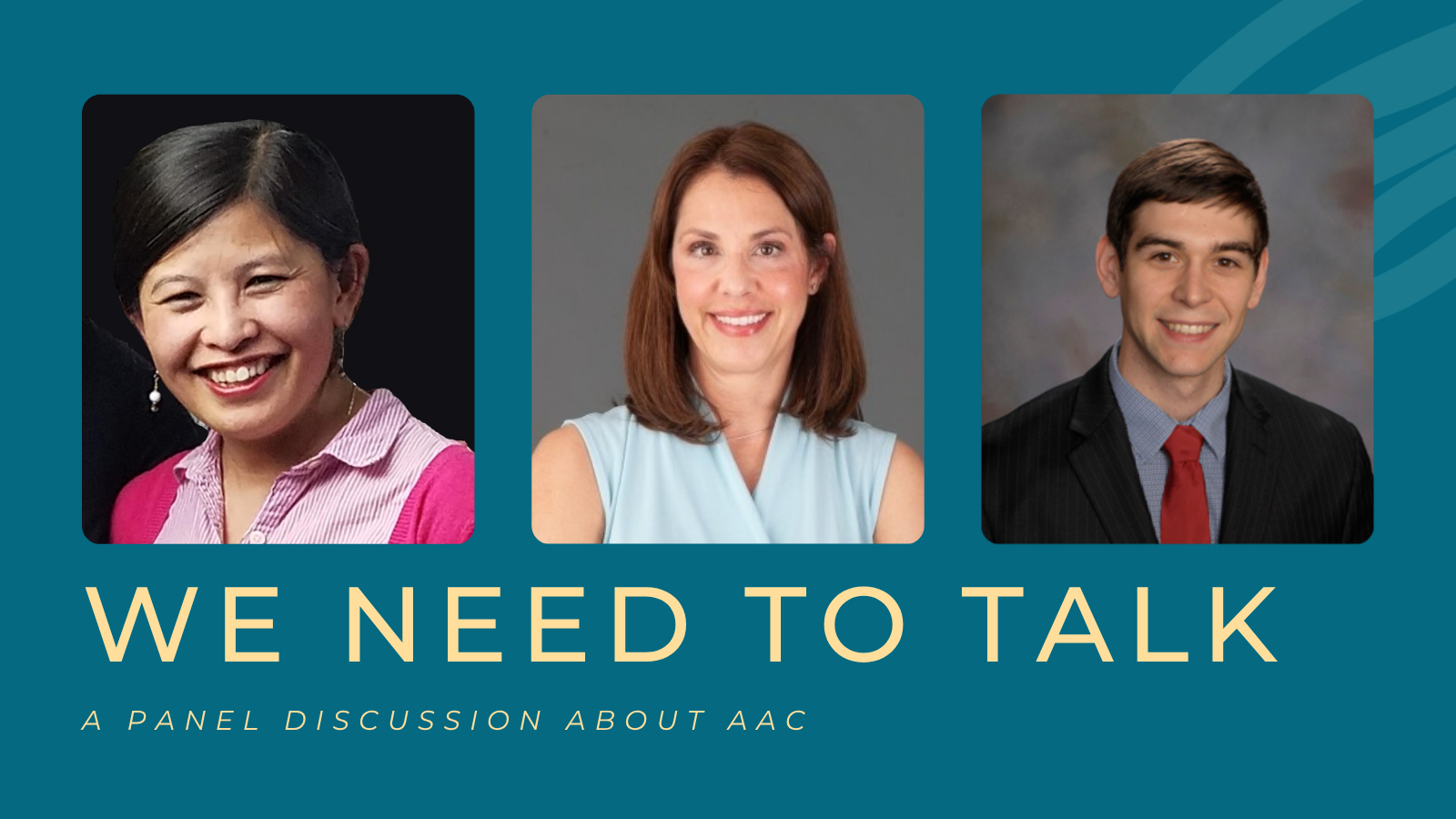
The Guild hosted a webinar and panel discussion expanding on the themes of the documentary, "We Need to Talk". The panelists explored personal AAC stories, common barriers and solutions to inclusive community environments, and discussion for improving communication accessibility in healthcare, education, and business.
The recording of the webinar is available here.
The premiere of "We Need to Talk" left the audience with three commitments: pause and wait, presume competence, advocate for access. During the webinar, the panelists talked about how to do those things in real contexts – emergency rooms, classrooms, restaurants, transitions to adulthood.
What will you do differently tomorrow?
|
Resources shared during the event by panelists and the audience
Navigating healthcare
- If you are going through medical insurance to get funding for an AAC device, ask what your benefits for a speech-generating device are. The health insurance code used is E2510.
- You can use this downloadable and printable form to create a healthcare passport with your primary care physician and health care team.
Education and training for parents and caregivers
- The Northwest Augmentative Communication Society has a library of resources for supporting AAC users across the lifespan.
- The Angelman Syndrome Foundation has a course with AAC training, activities, and videos for parents to support their child's communication journey.
- PrAACtical AAC has resources, blogs, and events from a community of professionals and families determined to improve the communication and literacy abilities of people with significant communication difficulties.
- The Vietnamese Parent Project is a hub of collective resources shared by and for parents and caregivers of AAC users.
- OpenSymbols is a collection of open-licensed (free access) picture symbols that can be used for augmentative communication.
Additional resources:
- People have a fundamental right to communicate in all parts of their lives. The Communication Bill of Rights ensures the basic rights of persons with severe disabilities to affect, through communication, the conditions of their existence.
- Learn about Assistive Technology Services available through Massachusetts DDS and DDS Providers.
- The language we use to describe ourselves and others has lasting implications. Some have shifted away from the term ‘nonverbal’ in favor of ‘nonspeaking’ to describe individuals who use modalities other than speech to communicate. Corrina Riggs, M.A., SLP-CCC, discusses the debate between these two terms and why language matters on The Guild's blog.
Support ongoing events and AAC education, access, and advocacy through an optional donation to The Guild.