Improving communications and behavior

Our goal is to support our students to become the most independent communicators they can be to enhance engagement with others and quality of life. We believe that communication is a human right, and every individual deserves to be heard. Our therapists know that all behavior is communication, and that communication deserves to be acknowledged regardless of the mode utilized. 

We use evidence-based approaches for communication and social interaction for students with Autism and intellectual impairments such as Augmentative and Alternative Communication (AAC) strategies, functional communication training, staff coaching and training, social narratives, video modeling, and social skills training.

Augmentative and Alternative Communication (AAC)

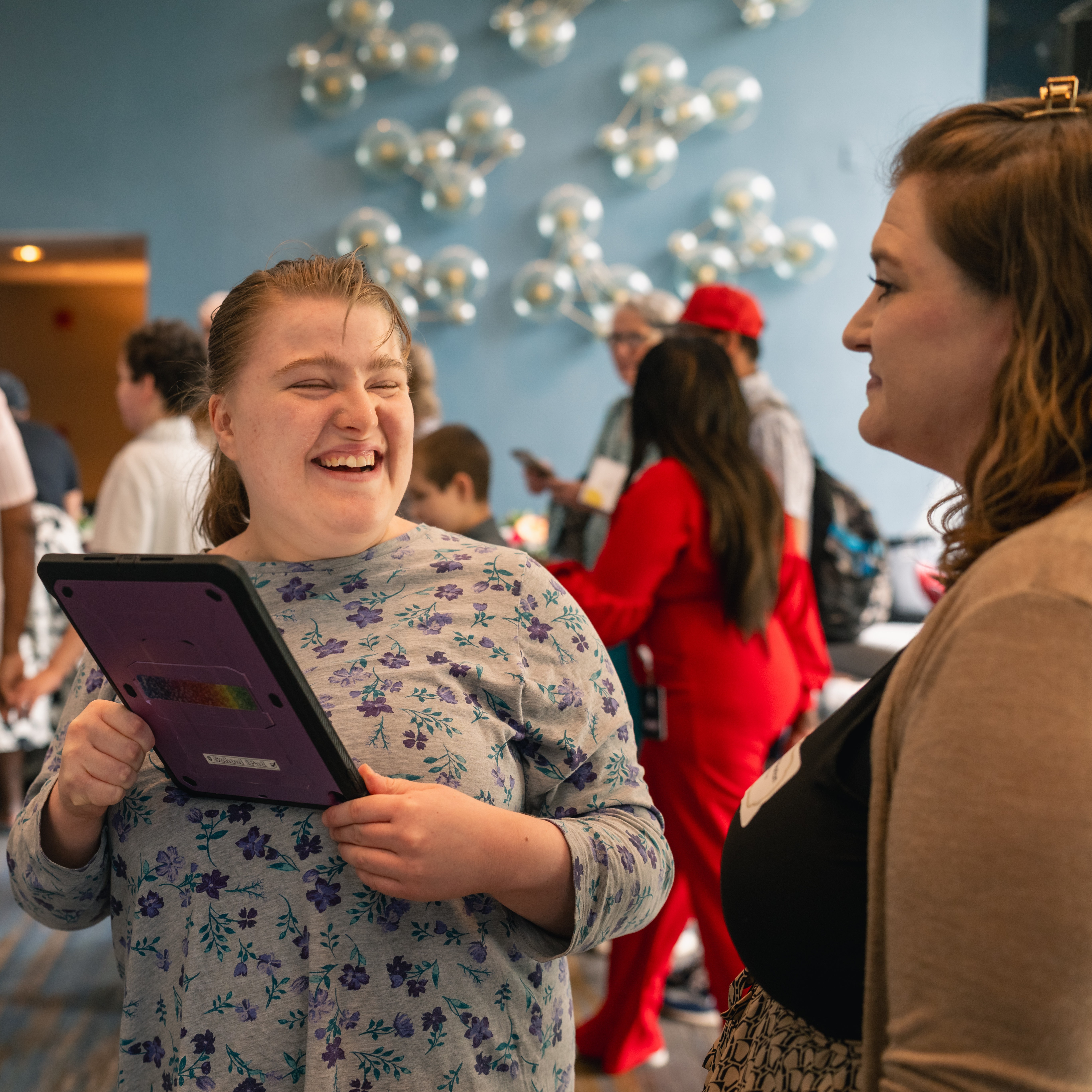
The Speech and Language Department at The Guild utilize a “total communication” approach, accepting and honoring all forms of communication, such as gestures, sign language, vocalizations, speech, and AAC. This includes high-tech options (e.g., speech-generating devices, communication apps) and lite-tech options (e.g., printed communication boards, speech-output buttons, environmental visuals). 

We pride ourselves on acknowledging and leveraging the current strengths of our students of all communication and developmental levels in order to develop independence and autonomy.  

Our entire team of Speech-Language Pathologists receives comprehensive, competency-based training in AAC, ensuring that every clinician is fully prepared to support students through all phases of AAC implementation—from initial evaluation and device trials to feature matching and goal development. Rather than relying on a single specialist, this team-wide approach was intentionally designed to provide greater flexibility and consistency, allowing students to receive expert AAC support seamlessly across different settings and providers. 

This model promotes better implementation and helps students generalize their AAC skills more effectively in their everyday school environments. Additionally, our Speech-Language Pathologists are experienced in obtaining speech-generating devices for students through routes of insurance, school districts, or personal funds. 

  • The Guild’s speech and language program

    The Guild:

    • Develops all staff orientation, pre-service, in-service and ongoing advanced training materials in communication disorders.
    • Identifies and assesses communication skills of all students immediately upon enrollment and subsequently on an ongoing basis.
    • Identifies, selects, implements and maintains appropriate communications systems based on individual student needs. These include aided (e.g., high- and low-tech characteristics) and unaided (e.g., spoken language, sign language, body language, etc.) systems.
    • Consults with multidisciplinary teams, including student caregivers, to implement, develop and generalize communication skills and systems across settings.
    • Develops and implements communications training programs as outlined in each student’s Individualized Education Plan (IEP).
    • Monitors and evaluates implemented programs, adjusting as necessary.
    • Performs formal reevaluation measures triennially, annually or biannually if deemed necessary and appropriate by student’s team.
    • For students with medically complex communication needs (e.g., feeding and swallowing), The Guild may refer the student for evaluation at an appropriate community organization. Guild professionals are trained to implement community organization recommendations.
  • Student communications

    Manual sign, assistive technology devices, and augmentative and alternative communications skills training are used to supplement a student’s verbal speech or supplant when speech is not possible or not intelligible. Guild professionals ensure that each student is supported by at least one mode of expressive communication. However, many students utilize a combination (e.g., verbal speech supplemented by a speech-generating device). Students may also utilize high-tech devices for typing when handwriting is not an option. Professionals also ensure that each student has visual supports as necessary (e.g., visual schedules, social stories, picture sequences) to appropriately interpret and respond to their learning environment.

  • Social skills training

    Students with social language difficulties receive structured and unstructured social skills training. Professionals address social/pragmatic communications objectives individually as well as within didactic and group-based communications and speech/occupational therapy co-treatments. Students address skills using the Social Thinking Curriculum developed by Michelle Garcia Winner, including problem solving via social interpretation and responses, theory of mind training, self-advocacy and disability awareness training, among many others. By increasing effective communication and pro-social skills, students are more equipped to interact in meaningful ways with peers, coworkers, family and community members.

Corrina Riggs, SLPD, CCC-SLP

Senior Clinical Advisor of Related Services

Paige Castonguay, M.S., CCC-SLP

Speech-Language Pathologist

Kaitlin Robinson, M.S., CCC-SLP

Speech-Language Pathologist

Kirstin White, M.A., CCC-SLP

Speech-Language Pathologist